
Not sure why, but I haven’t been able to start writing my Paris blog this trip until now. Seems old habits die hard — as the saying goes. I give into doing other things first instead of writing. OK — here we are again. It has been three weeks of glorious weather in Paris, hard as it is to believe. We’ve enjoyed friends and family- and now we are almost to the end of our time here. But, now I had to write about the events of this past weekend – April 23 and 24 — here in Paris. April 24 as many of you know, is the day Armenians commemorate the Armenian Genocide, as on that day in 1915 there was a major round up of Armenian intellectuals in Istanbul. It was not the beginning, but that day heralded in the worst of what was yet to come.
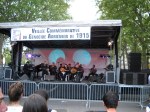
I found online the French Armenian community website which listed events for the weekend – starting on April 23 at Republic Square and finishing on April 24 at the Gomidas statue and memorial to the Armenian Genocide. We decided to attend as much as we could to add our bodies to anyone who might be counting and to get a flavor of these commemorations in Paris. On the 23rd, the occasion was sponsored by the young French Armenian community. And, indeed, mostly young people were in attendance gathered in Republic Sq. , partially closed to traffic with a stage set up for performances, a tent for the discussion forums and a poster exhibit addressing denial of the Genocide. There were probably about 250-300 people present at any one time, gathered all around and even sitting on the large monument in the center of the square.
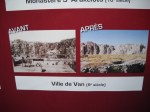
The rather detailed exhibit addressed ‘denial’ on several levels, but most interesting to us were the before and after photos of Armenian villages, historic Armenian sites and churches in Turkey: photos taken in or around 1915 and compared with those taken in the recent past. A photo is worth a thousand words? Yes! Comparative statistics were provided as well – number of inhabitants, Armenian churches, monuments, etc.
The first musical presentation was of an Armenian folk ensemble which included instruments such as the tar and the duduk. Well done! Then followed a number of non Armenian singing groups. Since we couldn’t understand the introductions given made in French well, we don’t really know why these groups were included. Perhaps it was the at the groups request to show solidarity with the Armenian cause against Denial.
We read through the exhibit, we listened to the speeches and music, and satisfied to happy to see this degree of involvement by Armenian French youth, we left. Interestingly, not a word of Armenian was spoken on either day, which surprised us! However, when we had occasion to speak to people a few times, we spoke in Armenian and the response was in Armenian. So — I have to conclude that most of the people present spoke and understood Armenian.
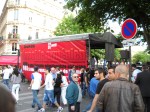
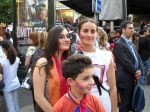
April 24: The commemoration began at the Arc de Triomphe, but we were late and missed that ceremony. But, in fact, we don’t know if the ceremony took place. There were military formations at the Arc, and beautiful French flag flying from the pinnacle, and shortly after we arrived, a military band appeared, marching up the Champs-Elysee toward the Arc. As nice as this was, we were disappointed thinking we had missed the Armenian Genocide ceremony. We started to walk down the Champs-Elysee with our purple tulips in hand (for laying at the Gomidas statue later) when we saw a huge red banner across George V Avenue, right in front of the Louis Vuitton multistory store. In French, “Genocide Armenien” written across the banner made it clear we hadn’t missed much and were now in the right place. Again we stayed, listened to the speeches, but more interesting we observed the gathering of many French Armenians – at least 3000 – all gathered and all quite nationalistic. (See the photos). The Armenian tri-colors were worn as shawls, as shirts, hats, scarves, carried as the flag it is, and even painted on faces. After an hour or more, we decided to walk to the Gomidas statue on our own and not wait for the procession.
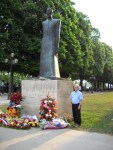
The Gomidas statue is itself a majestic monument which gives us a sense of pride every time we see it. But today, it had even more significance and effect on us as we thought about this composer-monk, tortured physically and emotionally by the acts of the Turks, who lost his mind and died in Paris in 1935.
As we approached the area we saw that a number of Armenians had already gathered around the monument waiting for the procession to arrive. And, we noted that there must have been a ceremony here earlier, as bouquets flowers had already been placed at the base of the statue by the Armenian Ambassador to France, the Mayor of Paris, the representative of “Haut-Karabagh”, and several other Armenian groups. Interesting — we wondered if these had been done prior to the general procession of Armenians coming, almost secretly, for security reasons. We have no idea!
George and I laid our purple tulips at the base of the statue in honor of our families and all Armenians everywhere, and especially for the little children who were murdered or enslaved by those who perpetrated this heinous crime of genocide.
It was a beautiful day. We crossed the Seine toward the place we call home when we are in Paris.



 pianomd
Carolann, you beautifully captured the spirit of the occasion and the place. Your beautifully written description reminded me of my experience on April 24th in Paris. What a wonderful tribute to our ancestors, in a uniquely French way. Bisous, Maral